



Why Accuracy Matters: Precision in OEM Surgical Navigation
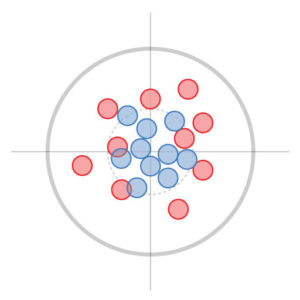
Trueness represents how close measurements are to the bullseye (the true reference value). In this example, the red and blue targets are both true, but the red measurements are less precise because they are far apart.
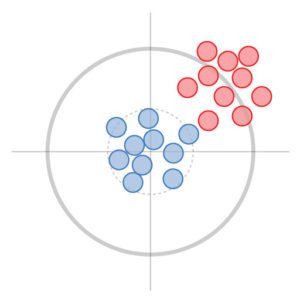
Precision represents how close repeated measurements are to each other (test results). In this example, the red and blue measurements are both precise, but the red measurements are less true because they are off target.
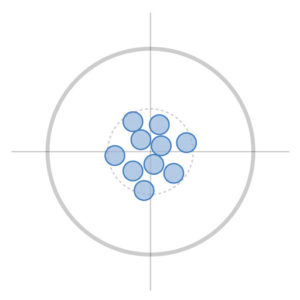
Accuracy represents measurements that are close to the bullseye and close to each other. In this example, as with all NDI optical measurement and electromagnetic tracking solutions, the measurements are both true and precise.
Measurement You Can Trust®
This focus on trusted measurement performance is evident throughout the design, manufacture, and integration of the Polaris, Aurora®, and 3D Guidance® solutions:
Characterization
Our characterization models are based on proprietary algorithms that leverage decades of progressive applied physics and mathematics research. These models encompass every conceivable aspect of 3D tracking to maximize spatial measurement accuracy.
End-to-End Design
Solution components are designed to work together, with an emphasis on minimizing systematic noise during measurement. Accuracy and repeatability are maintained among the different system components and throughout connection points.
Manufacturing Process
The design and manufacture of Polaris, Aurora and 3D Guidance components and passive spheres adhere to numerous ISO, IEC, UL, CSA, EC and other regulatory and quality standards, providing a reliable tracking system that operates exactly to stated accuracy specifications.
Factory Calibration
The accuracy and repeatability of 3D positions are verified using a coordinate measuring machine (CMM) within our manufacturing facility for validated measurement performance that optimizes trueness and precision. No in-field calibration is required.
Characterization
Our characterization models are based on proprietary algorithms that leverage decades of progressive applied physics and mathematics research. These models encompass every conceivable aspect of 3D tracking to maximize spatial measurement accuracy.
NDI’s optical measurement and electromagnetic tracking solutions adhere to the ISO 5725-4:2020 standard for trueness and precision. Our solutions are certified measurement systems, the outputs of which can be traced back to standards set by the National Institute of Standards and Technology (i.e., NIST traceable).