


Article
Electromagnetic Tracking
for a CT-Compatible Robotic
Needle Placement System
By: Tatjana Caron
CT-guided needle placement still runs on a stop-and-check rhythm. A clinician takes a scan, advances the needle a little, steps out of the room, scans again, and adjusts. In a difficult access path, that loop can repeat several times before the needle reaches its target, and every pass adds time and imaging.
That loop is the problem a new technology demonstrator sets out to explore, and electromagnetic tracking is central to how it does so. NDI built the demonstrator together with Demcon Life Sciences & Health and CIVCO Medical Solutions to answer a practical question for anyone developing image-guided devices: what happens when robotics, image fusion, and real-time position data share one workflow?
The challenge in CT-guided needle placement
Most of the engineering difficulty in CT-guided needle placement lives inside the scanner itself. Space is tight, line of sight is limited, and anything added to the setup has to survive the imaging field without distorting it. Those constraints are exactly why the iterative scan-adjust cycle persists, and why they make an interesting test bed for tracking technology.
Inside the CT-compatible robotic needle placement system
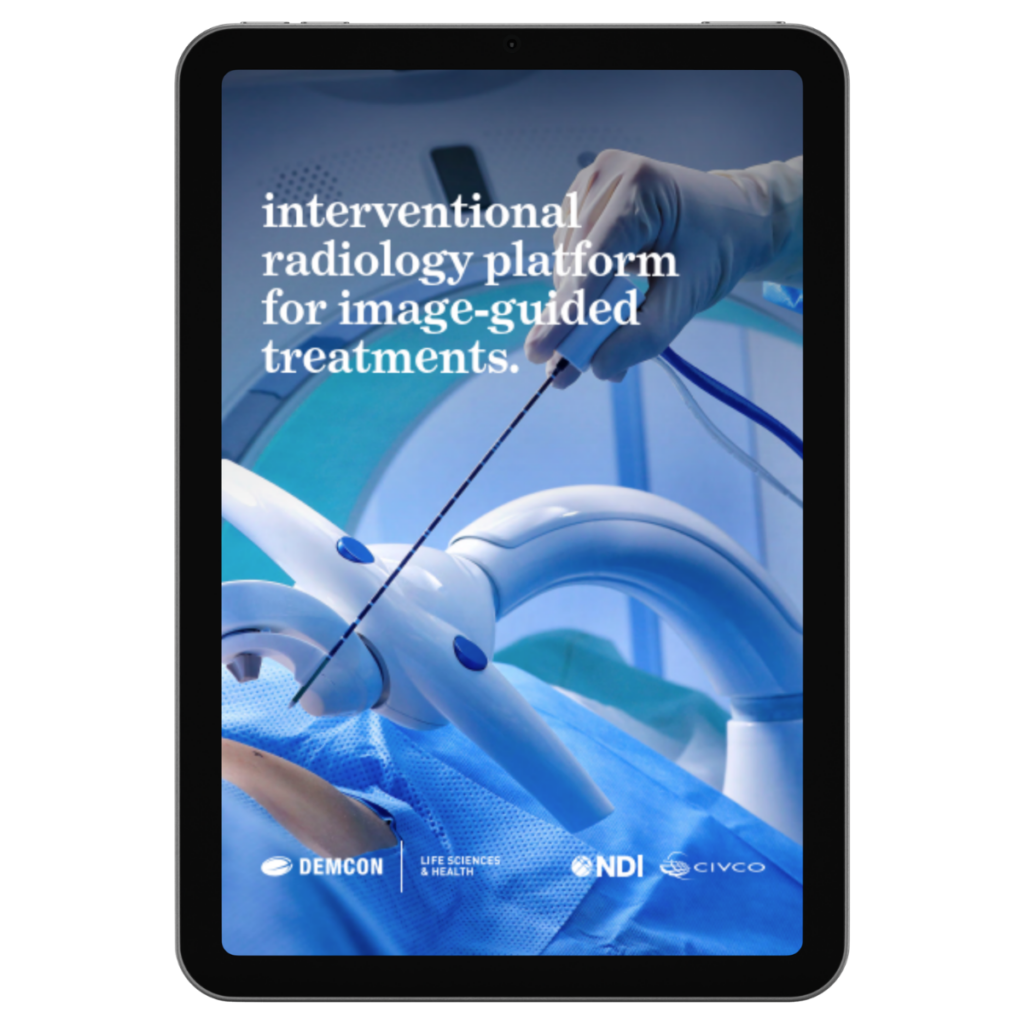
The demonstrator is a robotic, CT-compatible needle placement system. Demcon developed it and designed it to operate inside the CT environment.
CIVCO and NDI contributed the image fusion piece through two tracked elements: a tracked patient reference and a tracked needle. NDI provided the tracking technology underneath both, delivering real-time position data for the needle and for the procedural setup. That data is what lets the robotic and imaging pieces share a common frame of reference during insertion.
The system is not in commercial use. It is a technology demonstrator, built to show how these technologies combine and to open up questions worth pursuing in future device development.
How electromagnetic tracking works without line of sight
NDI’s part is the tracking layer. In this build, that means Aurora electromagnetic tracking technology paired with the Aurora Planar 20-20 X2 Field Generator, producing continuous position and orientation data for tracked instruments and reference points.
Electromagnetic tracking earns its place here for one reason: it does not need line of sight. Inside a CT bore, with a robotic head and draping in the way, optical approaches struggle. EM tracking keeps reporting position data whether or not the instrument is visible, which is what makes real-time localization workable in that setting. That property is what makes electromagnetic tracking suited to confined, visually obstructed setups well beyond this one demonstrator.
What the demonstrator means for OEM device development
For an OEM engineering or product team, the tracking data layer is the useful signal in this project. It is a building block you can design around, and it behaves the same way across a range of demanding applications where visibility is limited and space is constrained.
Demonstrators exist to prove that pieces fit before anyone commits to a product program. This one shows that robotic positioning, image fusion, and EM tracking can operate together in a genuinely hard environment. For teams weighing their own image-guided concepts, that lowers the guesswork at the front end, since the integration questions have already been worked through once.
Read the full white paper
The complete white paper covers the workflow, the integration approach, and the electromagnetic tracking technology behind the demonstrator, written for teams evaluating these technologies for their own development programs. It goes into the detail this post only gestures at: how the workflow is structured step by step, how the tracked reference and needle register to the imaging, and how the tracking foundation is designed to extend into other development directions.
We can also chat in person, NDI and Demcon will be at the Society of Robotic Surgery Annual Meeting in Hollywood, Florida, July 23 to 26, 2026. Find us at Booth 222, where we will be walking through the system, the development process, and the technologies behind it.