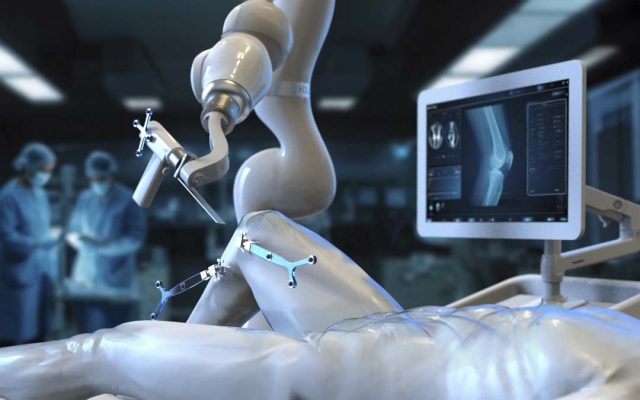
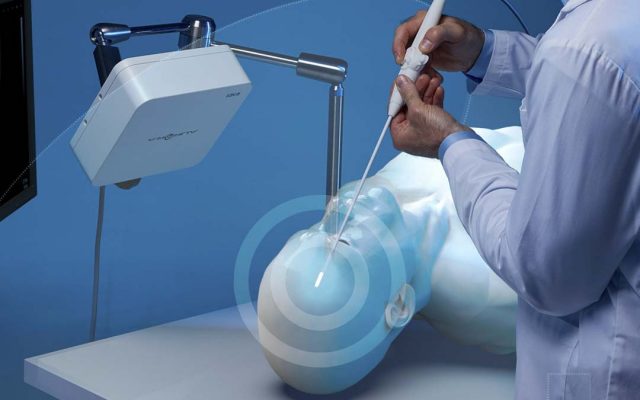
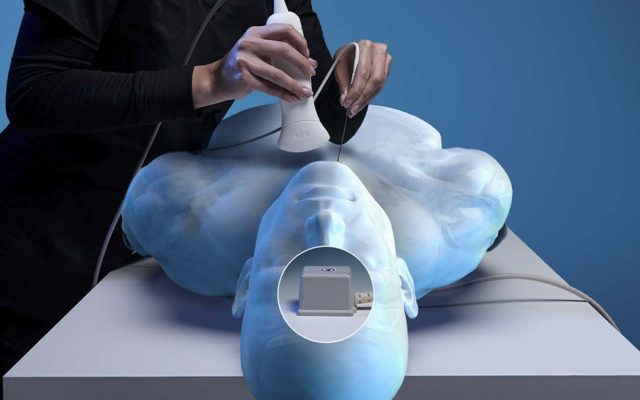
Both NDI Technologies track surgical instruments with a high level of accuracy, but each has their own set of advantages.
Optical Tracking
See how NDI’s Optical tracking technology uses infrared Optical Trackers to precisely track surgical instruments in real-time.
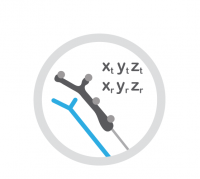
Electromagnetic Tracking
Discover how NDI’s Electromagnetic technology enables 6D tracking without line-of-sight requirements.
Optical Tracking – Principles of Operation
ThePolaris Vega andPolaris Lyra optical navigation solutions work by using near-infrared (IR) light to wirelessly detect and track navigation markers attached to OEM surgical instruments. They do so over a large measurement volume and with exceptional tracking accuracy and precision. Optical measurement technology is also known—and trusted—for its reliable tracking performance.
Optical markers (passive or active) are attached to surgical tools.
The Polaris® Optical Tracker floods the measurement volume with infrared (IR) light
Passive markers reflect IR light emitted by the tracker, while active markers emit IR light that the tracker detects.
The optical tracker detects the markers and calculates the tool’s position and orientation in 3D space.
Coordinates are mapped to patient images, creating a real-time view of the tool’s location relative to anatomy.
Real-time tracking data is sent to the navigation software for surgical guidance.
Electromagnetic Tracking – Principles of Operation
Aurora® electromagnetic (EM) tracking works by generating a defined EM field in which EM micro-sensors are tracked. Sensors can be embedded into OEM medical instruments such as catheters, endoscopes, guidewires, and needle tips. Using the sensors’ tracking data, the OEM image-guided surgery system can localize and visualize the instrument as it’s navigated through anatomical tracts to target and reach treatment areas.
Sensors can be embedded into an OEM medical instrument, where they serve as localization points for the instrument in 3D space.
The Field Generator emits a low-intensity, varying EM field that establishes the measurement volume.
Small currents are induced inside the sensors when they enter the EM field.
These currents are relayed to the Sensor Interface Unit (SIU), where they’re amplified and digitized as signals.
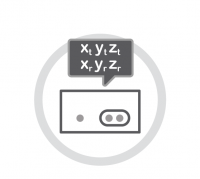
The signals are transmitted to the System Control Unit (SCU), which calculates each sensor’s position and orientation as a transformation.
Tracking data are communicated to the OEM host application interface for real-time navigation of instruments relative to patient image sets.
Choosing the Right Technology
Optical Tracking
Ideal for procedures where instruments remain visible, providing sub-millimetre accuracy even in environments where metal interference is present.
4+ Optical Tracker configurations and 3+ marker options
Sub-millimetre accuracy across surgical and research applications
Ready-to-use tools for research and development.
Electromagnetic Tracking
Ideal for tracking flexible or rigid instruments inside the body where line of sight is obstructed.
Sensors as small as 0.3 × 2.5 mm
Track up to 32 sensors simultaneously
Plug & Play tools available for research and development
Key Differences at a Glance: Compare Optical and Electromagnetic Tracking
Optical Tracking
Electromagnetic Tracking
Line of sight
Requires line of sight
No line of sight required
Instrument Type
External rigid instruments
Internal flexible instruments
Equipment
Optical Trackers & Markers
Electronic Units, Field Generators & Sensors
Advantages
Large measurement volume
Sensors as small as 0.3 × 2.5 mm
Product Line
Polaris®
Aurora®
Polaris® Optical Product Suite
The complete Polaris® Optical tracking system relies on two primary components working together: an optical tracker and optical markers.
The capabilities of NDI’s Optical technology make it ideal for integration into OEM robotic and computer-assisted surgical navigation systems in cranial, spine, and orthopaedic surgery.
Cranial
Supports OEM navigation systems used in neurosurgical and neuromodulation procedures involving the brain and skull.
The Aurora® and 3D Guidance® Electromagnetic Product Suite
NDI offers two electromagnetic tracking platforms, depending on system and integration requirements.
Aurora® Electromagnetic Product Suite
The complete Aurora® Electromagnetic tracking system relies on three primary components working together: Electronics Units (System Control Unit & Sensor Interface Unit), a Field Generator and Sensors.
The complete 3D Guidance® Electromagnetic tracking system relies on three primary components working together: an Electronics Unit, a Transmitter and Sensors.
NDI’s electromagnetic tracking technology provides position and orientation data designed for integration into OEM navigationsystemsincorporating instruments such as endoscopes, guidewires, catheters, and needle tips.
Cardiology
Supporting OEMs developing systems for cardiac electrophysiology and catheter-based interventional workflows.