


Article
From Concept to Proof Point:
How Three Companies Prototyped
a Successful Image-Guided Device Together
By: Tatjana Caron
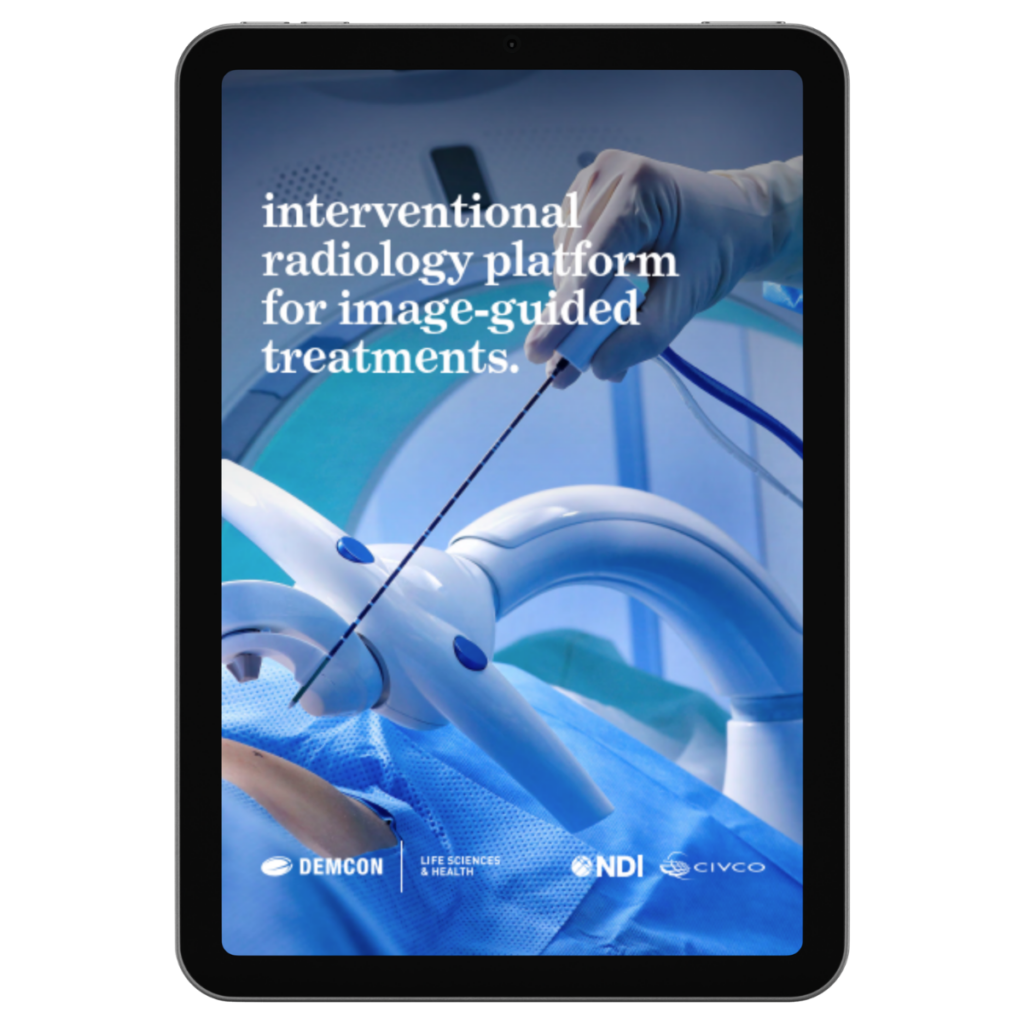
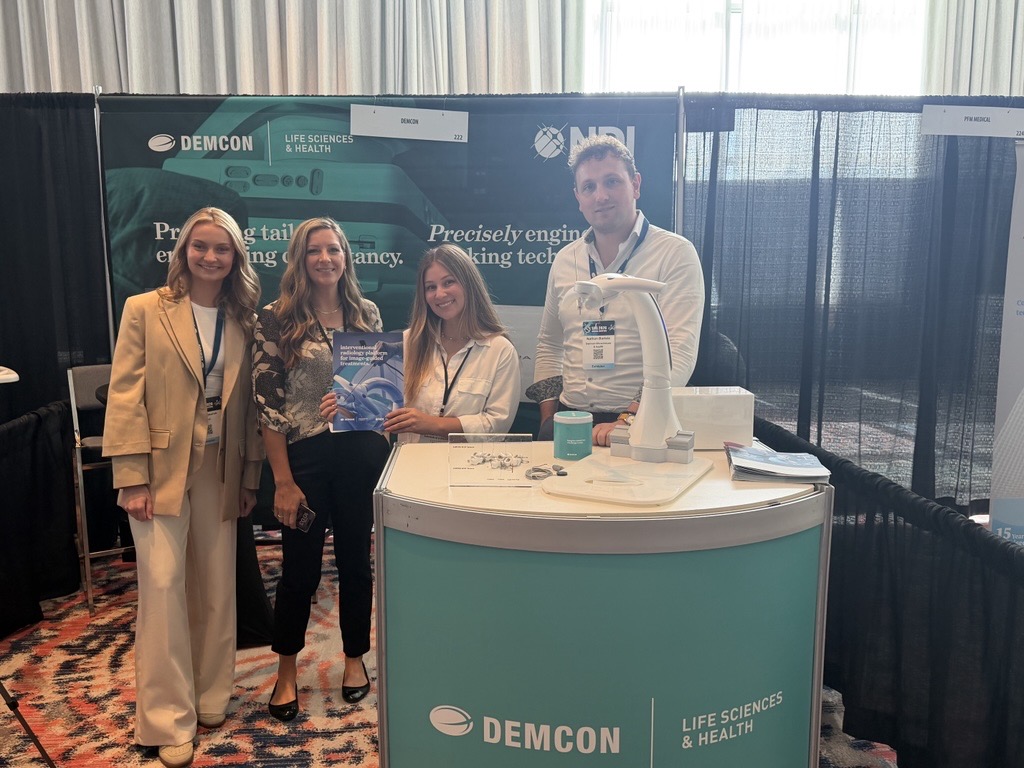
We recently teamed up with Demcon Life Sciences & Health and CIVCO Medical Solutions to build a robotic, CT-compatible needle placement demonstrator, detailed in our white paper “Interventional Radiology Platform for Image guided Treatments”.
Here’s a more conversational look at how that collaboration came together.
The problem we’re collectively solving
Picture a typical CT-guided liver or kidney biopsy: scan, insert the needle a little, step out of the room for another scan, check the trajectory, go back in, adjust, repeat. On a difficult access path, that loop can run several times before the needle is on target.
I’ve seen this firsthand, sitting in on procedures in Paris, France, where this exact rhythm played out. “clear the room!”, scan, review, go back in, adjust. It’s a strange thing to watch: a room full of skilled people, pausing the procedure over and over because the only way to confirm position is to leave and re-scan.
Every cycle adds time, radiation exposure, and friction for the clinician. That loop is what we set out to address.
How NDI, Demcon and CIVCO work together
This is probably the most natural question to ask, so let’s answer it directly.
Each of us solves a different piece of the puzzle, and none of us solve all of it alone.
Demcon Life Sciences & Health is a contract engineering partner for medical device and biotech companies. They take ideas from “we think this could work” all the way through to something that’s actually manufacturable and regulatory-ready. In this project, they built the robotic needle positioning platform itself and acted as the system integrator, the ones stitching hardware, software, and workflow into something that actually functions as one system.
CIVCO Medical Solutions brings the clinical interface — the parts that are proven, familiar, and already trusted in procedure rooms. They contributed the omniTRAX Active Patient Tracker (for automatic patient reference registration) and the eTRAX Needle Tip Tracking Guidance System, which handles real-time electromagnetic needle tip tracking during the procedure.
NDI does tracking. Specifically, we do it without needing a clear line of sight, which turns out to matter a lot inside a CT bore where there’s a robotic head, draping, and general clutter in the way of any camera. We supplied the Aurora electromagnetic tracking system, paired with the new Aurora Planar 20-20 X2 Field Generator, to provide continuous real-time position and orientation data for both the needle and the patient reference.
Put those three things together, and you get robotic precision, a clinically trusted interface, and real-time positional awareness that doesn’t care whether anything is visible or not. None of us could have built the whole demonstrator alone because none of us actually do all three of those things.
Is this a medical device you can buy?
No, and this is a point worth being clear about, because it’s easy to read “robotic CT-compatible needle placement system” and assume it’s a finished product already sitting in a hospital somewhere.
It’s a technology demonstrator. It’s not in commercial use, and it isn’t cleared for clinical use. It is proof that these pieces (robotic positioning, image fusion, and electromagnetic tracking) can actually work together in a genuinely difficult environment. CT bores are tight, visually obstructed, and unforgiving of anything that interferes with imaging. Getting all three technologies to cooperate in that space, reliably, isn’t trivial.
What this means for a medical device OEM
This demonstrator isn’t the product. It’s the proof that the building blocks for a product like this already exist and already work together. For a medical OEM looking at a similar concept — whether that’s liver biopsy, lung biopsy, urology, neurosurgery, or endovascular work — the hard integration questions have already been worked through once. That’s a lot of guesswork removed from the front end of a development program.
If you’re an OEM team with an idea in this space, our pitch isn’t “here’s a product.” It’s: we can take you from a rough concept all the way to a finished product, the same way we did here — Demcon on the engineering and integration side, CIVCO on the clinical interface side, and NDI on the tracking layer that ties it all together.
Read the full white paper
If you want the deeper technical breakdown — the workflow step by step, how registration works between the tracked reference and the imaging, and how the tracking foundation is designed to extend into other applications — the full white paper covers all of that.