



Tracking Components for
OEM Robotic and Navigation System Integration
NDI delivers sub-millimeter tracking in real time¹.
Build on more than four decades of tracking expertise without developing the tracking subsystem in-house.
OEM surgical tracking
inside and outside
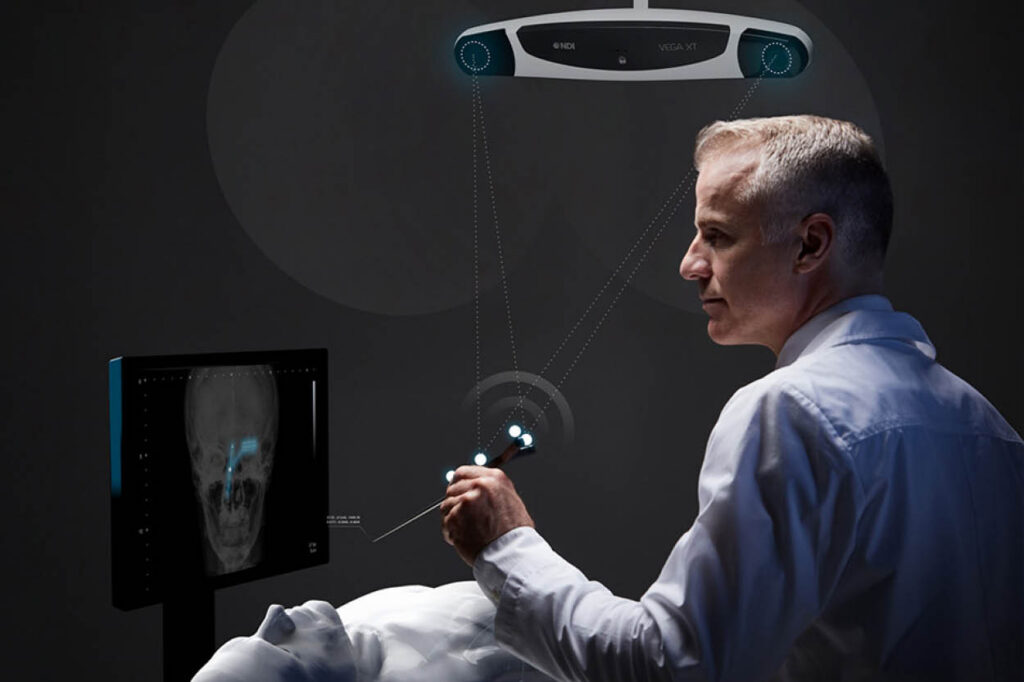
Optical for OEM line-of-sight tracking. Electromagnetic for OEM designs where sight is obscured.
Precision that OEMs
can build on
Sub-millimetre positional data under defined conditions, for evaluation in your system design.¹
Support for your
development timeline
Integration-ready SDKs and established components support OEM evaluations and development.
An integration partner
at each stage
NDI integration specialists help you configure components for OEM system requirements.
Tracking components integrated into OEM-developed robotic and navigation systems.*
Optical and electromagnetic tracking technology from one supplier.
Top medical device OEMs build on 45+ years of tracking innovation and expertise.
OEM Robotic and Navigation Systems
Position data for OEM robotic and navigation systems
OEM-developed robotic and navigation systems use real-time position and orientation data within their architectures. NDI optical tracking components provide this data where tracked markers remain visible to an optical tracker. Application suitability and performance are determined through OEM verification and validation.
AI-Assisted OEM System Development
Real-time tracking data for AI-assisted OEM systems
AI-assisted OEM systems may incorporate real-time position and orientation data as one input within their architecture. NDI tracking components provide this data for evaluation and integration. OEM developers determine system-level performance and suitability through design, verification, and validation processes.
OEM Electromagnetic System Design
Position data where direct line of sight is unavailable
OEM-developed devices may require tracking where direct line of sight is unavailable. NDI electromagnetic components provide position and orientation data using sensors as small as 0.3 × 2.5 mm. OEM customers determine suitability and system-level performance through their verification and validation processes.
How we help
NDI integration specialists help your engineering team evaluate optical trackers, markers, electronic units, field generators, sensors, development tools, and accessories. We work with you to select a component package aligned with your technical and integration requirements. Precisely.
Optical or Electromagnetic
Two tracking technologies, configured for your OEM system
Polaris® Optical Tracking
For OEM system designs in which tracked markers remain visible to an optical tracker. Polaris components provide position and orientation data for integration into OEM robotic and navigation systems.
Components available:
- Optical trackers
- Passive, Active, and Radix™ markers
- Development tools and accessories

Aurora® Electromagnetic Tracking
For OEM device designs where line of sight is obstructed. Aurora components provide position and orientation data through compact sensor configurations designed for integration into OEM devices.
Components available:
- Electronic units and field generators
- Electromagnetic sensors
- Development tools and accessories
GET THE Technical Overview BROCHURE
Start evaluating
NDI tracking components
for your OEM system
What’s inside:
- Our standard product portfolio in one place.
- Specifications you can design against.
- The breadth of OEM applications.
- A clear integration pathway.
- 45 years of tracking expertise behind your development.
Frequently asked questions
What does NDI supply?
NDI supplies optical and electromagnetic tracking components that OEM customers configure and integrate into their own systems. Available components include optical trackers, markers, electronic units, field generators, sensors, development tools, software, and accessories.
How do I choose between optical and electromagnetic tracking?
Optical tracking is suited to OEM system designs where tracked markers remain visible to an optical tracker. Electromagnetic tracking is suited to device designs where line of sight is obstructed. NDI integration specialists can help your engineering team evaluate the appropriate technology and component configuration.
How small are the electromagnetic sensors?
Aurora electromagnetic sensor configurations as small as 0.3 × 2.5 mm are available. Component selection depends on the OEM application, device architecture, and technical requirements.
What accuracy can I expect?
NDI optical tracking components provide sub-millimetre positional data under defined conditions. Actual system-level performance depends on component selection, configuration, operating conditions, integration, and OEM verification and validation.
Does NDI provide integration support?
Yes. NDI integration specialists work with OEM engineering teams during component evaluation, configuration, prototype development, and technical integration.
What development tools are available?
NDI offers software, development tools, accessories, and component options that support OEM evaluation and prototyping. Development accessories are intended for evaluation and prototyping purposes only. They are not intended for clinical use.
Has NDI tracking technology been integrated into OEM medical devices?
NDI has a track record of supplying tracking components for integration into OEM-developed robotic and navigation devices. The OEM is responsible for determining suitability and completing system-level testing, verification, validation, certification, and applicable regulatory submissions.
Can NDI tracking data be evaluated for AI-assisted OEM systems?
OEM developers may evaluate NDI’s real-time position and orientation data as one input within an AI-assisted system architecture. The OEM is responsible for determining suitability and validating system-level performance.
How do I get started?
Download the technical overview to evaluate NDI’s tracking component portfolio, or speak with an NDI integration specialist about your technical requirements.
¹ Component performance depends on the selected configuration, operating conditions, system integration, and OEM verification and validation.
* The Aurora® tracking system, Polaris Vega ®, Polaris Lyra®, and Polaris Radix™ Lens are general metrology products, and are not approved, cleared or developed for medical use. Suitability of these products in a particular application must be determined by the OEM customer or the end user. NDI has not validated or otherwise tested these general metrology products for any medical purpose. Testing, certification, and validation are the responsibility of the original equipment manufacturer or the end user and should be completed prior to use in any application, or any other application involving living humans. The NDI Passive Sphere is an FDA-regulated medical device.