



Article
What We Learned at SRS 2026
Five takeaways from the Society of Robotic Surgery Annual Meeting in Hollywood, Florida
By: Team NDI
We spent four days in July at the SRS 2026 Annual Meeting walking the floor, at our booth and talking to the people building the next generation of surgical robots. Between the OEM conversations, the startup demos and industry talks, a few themes came up often enough that they’re worth writing down. Here’s what stood out.
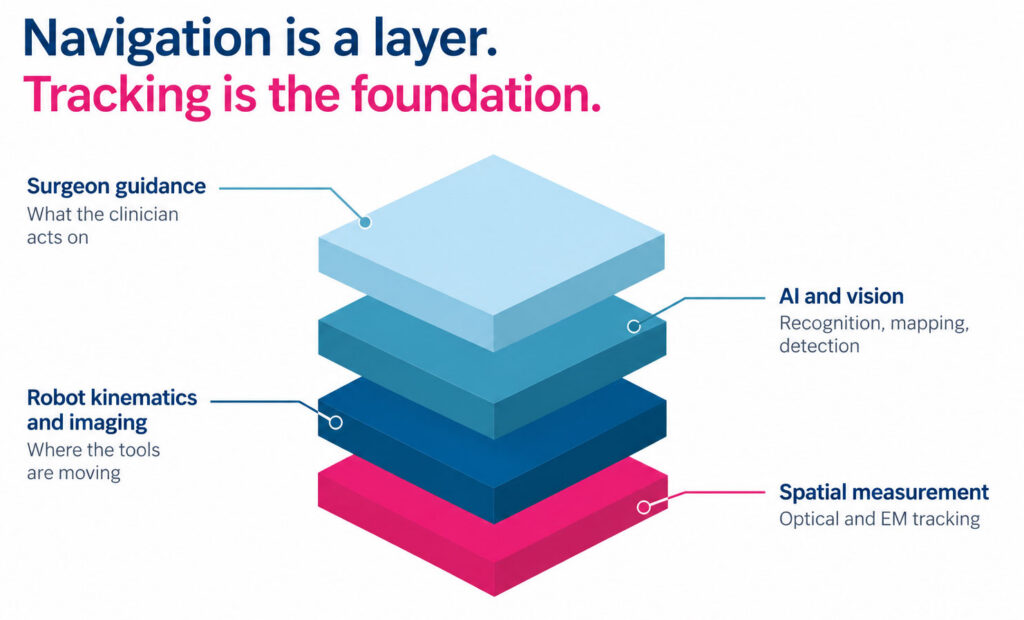
1. Navigation is described less as a box and more as a layer
The clearest signal we heard: AI, imaging, robot kinematics and tracking are increasingly discussed as one guidance system rather than separate components. Few of the teams we spoke with described navigation as “the tracker” in isolation. In our conversations, navigation increasingly meant a combination of imaging, visualization, tracking and robot awareness. The discussion was about how those capabilities work together across a procedure.
For tracking, that creates an important role: providing spatial measurements that developers can integrate with other sources of information. As platforms incorporate more AI and vision, understanding the accuracy, limitations and behavior of those measurements becomes increasingly important.
2. Integration is a central design priority
OEMs repeatedly raised practical questions: How much space does a component need? How does it fit into setup? Can it work with existing instruments and software? What does it mean for disposable costs?
Accuracy remains essential. Alongside it, teams are weighing the work required to integrate tracking into a complete platform.
For NDI, those conversations reinforce the importance of sensor and camera size, flexible system configurations and accessible software interfaces. These are engineering considerations that shape how a component fits into an OEM’s design and intended workflow.
3. Optical tracking is well established
Optical remains widely used in orthopedic and spine navigation, and nothing at SRS suggested that is changing. What came up in conversation was the architecture around it.
Two directions were raised repeatedly. First, interest in markerless and less-invasive approaches, motivated by a desire to reduce reliance on patient-mounted references. Second, exploration of vision positioned closer to the robot rather than across the room.
Both of these are opportunities for optical technology.
4. AI is bringing measurement data into focus
Many of the emerging platforms we saw described AI for anatomical recognition, lesion detection, visual mapping or navigation guidance. AI was also a formal theme of the meeting programme rather than only a floor conversation. [1]
The practical consequence teams described is that data properties matter alongside real-time output. Tracking data that can support model training, validation, drift detection and workflow analysis was described as more useful to these groups than a position stream alone. Measurement data that is consistent and well characterized is easier to train and verify against, which brings tracking into the AI discussion rather than keeping it separate from it.
[1] Society of Robotic Surgery, SRS 2026 post-meeting summary — https://srobotics.org/
5. A joint demonstrator made integration tangible
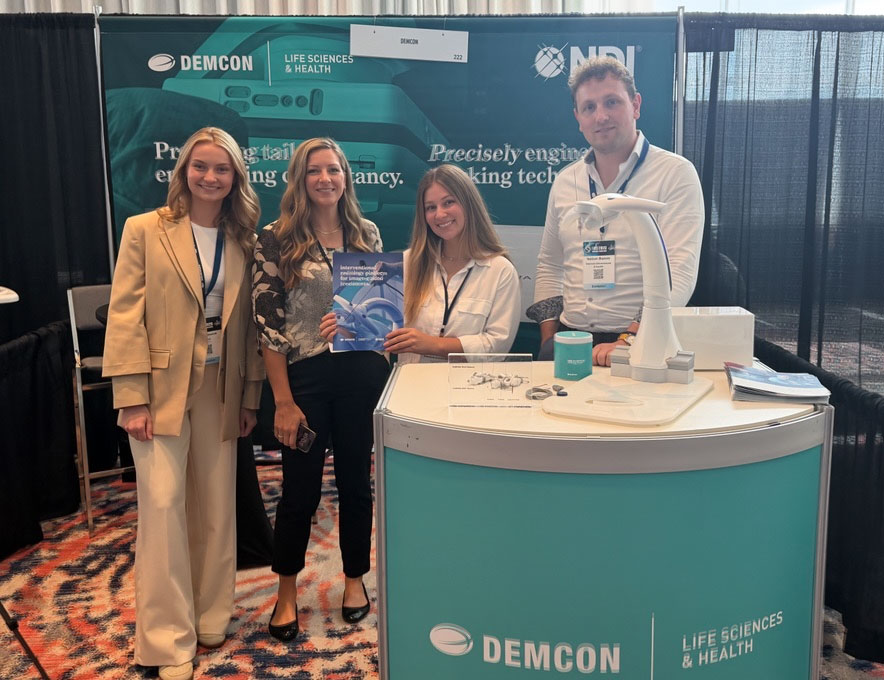 Running through the above is a question OEM teams ask regularly: can electromagnetic tracking support a robotic application, or is it better suited to catheters and scopes? Rather than argue the point, we brought something people could look at.
We co-hosted our booth with Demcon Life Sciences & Health and brought the demonstrator we built together with Demcon and CIVCO Medical Solutions: a robotic, CT-compatible needle placement system.
Three companies, three pieces:
Demcon
Demcon built the robotic needle positioning platform and acted as system integrator — the ones stitching hardware, software and workflow into something that functions as a single system.
CIVCO
CIVCO contributed the clinical interface: the omniTRAX Active Patient Tracker for automatic patient reference registration, and the eTRAX Needle Tip Tracking Guidance System.
NDI
NDI supplied the tracking layer — Aurora electromagnetic tracking paired with the new Aurora Planar 20-20 X2 Field Generator, giving continuous real-time position and orientation for both the needle and the patient reference.
The project provided a concrete way to discuss the interfaces between robotic positioning, imaging and tracking.
Electromagnetic tracking does not require an optical line of sight between a camera and the tracked sensor. That characteristic makes it relevant to discussions about constrained, visually obstructed configurations such as those explored in this project.
For OEMs, the value of the demonstrator is the opportunity to examine an integration approach and the engineering questions it raises. Any resulting medical device would require its own verification, validation and applicable regulatory authorization.
Note:
An important qualification is that this is a technology demonstrator. It is not in commercial use and it is not cleared or approved for clinical use, and no claims are made here about clinical performance, safety or benefit. What it was built to show is that these three technologies can be integrated and operated together inside a CT bore — an environment that is physically tight and visually obstructed, where a camera has no usable view of the needle.
Interventional Radiology Platform for Image-Guided Treatments
Demcon, CIVCO and NDI have written up the full technical detail — the workflow step by step, how registration works between the tracked reference and the imaging, and how the tracking foundation extends into other applications — in a white paper:
“Interventional Radiology Platform for Image-Guided Treatments.”